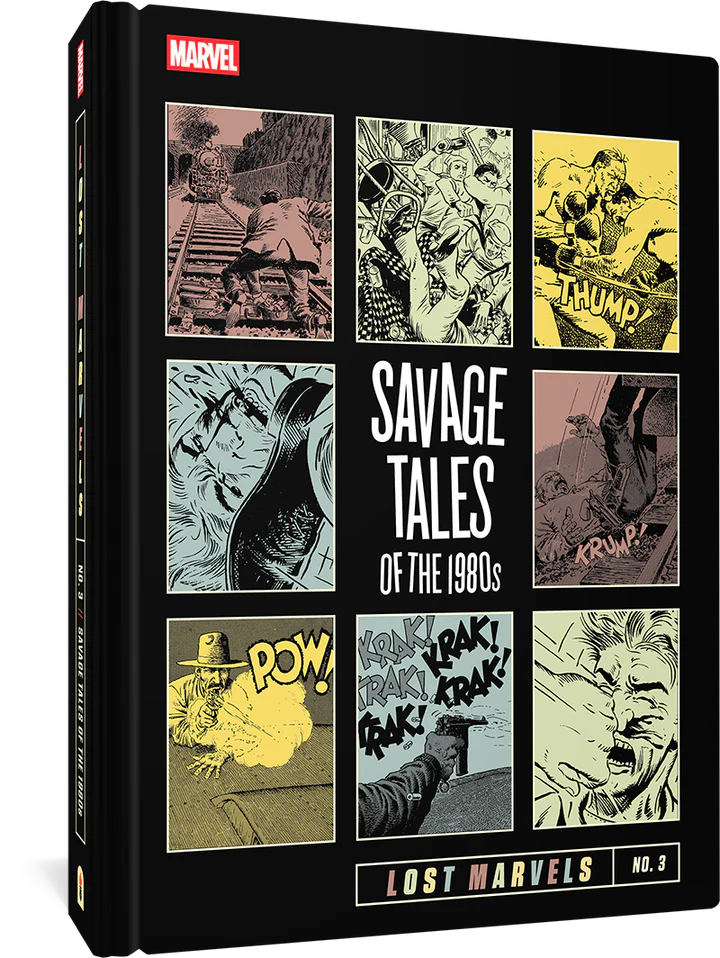
This month, Fantagraphics is continuing their ongoing project of revisiting some of the more unpredictable corners of Marvel Comics’ archives with Lost Marvels No. 3: Savage Tales of the 1980s. As the title suggests, this volume brings together a collection of short comics edited by industry legend Larry Hama, and featuring a look back from Hama on this period in his career.
I don’t know why, as a secular Jew, I am fascinated with crises of faith, and with Catholicism in particular, but the topic is a lifelong preoccupation. In this light, I was eager to dive into Christopher Beha’s Why I am not An Atheist: The Confessions of a Skeptical Believer.
Darius Jones sits alone on stage minutes before tonight’s show at the Cunneen-Hackett Arts Center in Poughkeepsie, calmly detonating blasts from his alto saxophone, two-to-three second streaks booming across the theater and fading to a moment’s silence just in time for the next one. They’re foghorn loud, piercing, but they seem like more than mere warm up exercises. Perhaps he’s testing the structural integrity of the joint and/or mapping the room’s acoustics—gauging the capabilities of tonight’s worksite and the best ways to utilize them.
Is it still snowy outside your door? Despite slightly non-polar weather the last few days, the snowdrifts remain high and the puddles are murky. Also, we have some literary recommendations for you this month: a wide range of books, from a deep dive into a Nobel laureate’s work to an unexpected work of autofiction.
The guiding principle of Six Ridiculous Questions is that life is filled with ridiculousness. And questions. That only by giving in to these truths may we hope to slip the surly bonds of reality and attain the higher consciousness we all crave. (Eh, not really, but it sounded good there for a minute.) It’s just. Who knows? The ridiculousness and question bits, I guess. Why six? Assonance, baby, assonance.
In a 2009 essay on the works of pioneering writer Lord Dunsay, Jo Walton explained his significance to the world of uncanny fiction. “Lord Dunsany wasn’t writing fantasy, because what he was writing was defining the space in which fantasy could later happen,” Walton wrote — and praised his ability “to take poetic images and airy tissues of imagination and weight them down at the corners with perfect details to craft a net to catch dreams in.”
Author Chelsea Sutton’s Krackle’s Last Movie, out now from Split/Lip Press, is one monster of a novella – a post-modern Prometheus, if you will (you don’t have to).
The book itself is a patchwork of found footage, oral history, and the inner thoughts of our reluctant protagonist, Harper. It’s the story of a mentor gone missing, a tragic death onstage, and interviews with “real-life” monsters whose lives glance, sometimes violently, off the human world. As she splices, rewinds, and reconstructs Krackle’s decades of encounters with werewolves, mermaids, invisible dancers, and desert sea monsters, Harper finds herself piecing together truths behind her own life secrets, as well as those that led to both Krackle’s disappearance and the Great Merlan’s last trick.
A little context can go a long way, especially when it’s from knowledgeable guides. My first encounter with Vernon Lee’s uncanny fiction came when I read the collection The Virgin of the Seven Daggers. I will confess that I don’t remember much else about it, the fact that I was reading it in 2020 goes a long way towards explaining that. I enjoyed Lee’s work enough that I was excited to see a new version of her 1890 collection Hauntings published with a conversation on the book (and Lee’s work) by Gretchen Felker-Martin and Kayla Kumari Upadhyaya.
ID used to identify users for 24 hours after last activity
24 hours
_gat
Used to monitor number of Google Analytics server requests when using Google Tag Manager
1 minute
_ga
ID used to identify users
2 years
_gali
Used by Google Analytics to determine which links on a page are being clicked
30 seconds
_ga_
ID used to identify users
2 years
__utmz
Contains information about the traffic source or campaign that directed user to the website. The cookie is set when the GA.js javascript is loaded and updated when data is sent to the Google Anaytics server
6 months after last activity
__utmv
Contains custom information set by the web developer via the _setCustomVar method in Google Analytics. This cookie is updated every time new data is sent to the Google Analytics server.
2 years after last activity
__utmx
Used to determine whether a user is included in an A / B or Multivariate test.
18 months
__utmt
Used to monitor number of Google Analytics server requests
10 minutes
__utmb
Used to distinguish new sessions and visits. This cookie is set when the GA.js javascript library is loaded and there is no existing __utmb cookie. The cookie is updated every time data is sent to the Google Analytics server.
30 minutes after last activity
__utmc
Used only with old Urchin versions of Google Analytics and not with GA.js. Was used to distinguish between new sessions and visits at the end of a session.
End of session (browser)
_gac_
Contains information related to marketing campaigns of the user. These are shared with Google AdWords / Google Ads when the Google Ads and Google Analytics accounts are linked together.